Author: rex

  • Question 2

    Introductory Post Copy

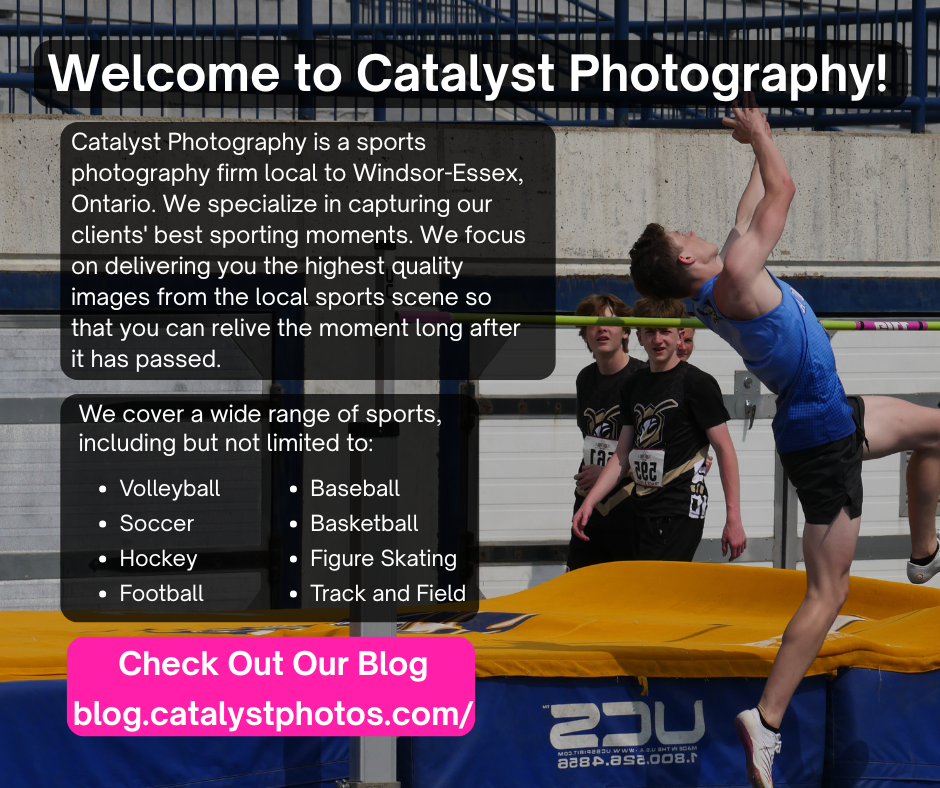
    Welcome to Catalyst Photography!

    Catalyst Photography is a sports photography firm local to Windsor-Essex, Ontario. We specialize in capturing our clients’ best sporting moments. We focus on delivering the highest quality images from the local sports scene so that you can relive the moment long after it has passed.

    We cover a wide range of sports, including but not limited to:

    • Volleyball
    • Soccer
    • Hockey
    • Football
    • Baseball
    • Basketball
    • Figure Skating
    • Track and Field

    Check Out our Blog

    http://blog.catalystphotos.com/

  • Question 1 c

    Plain English writing for the web differs slightly from other avenues, but at the root, it is still the same. On the web, you are fighting every other website for page views and readers. If a reader does not like your content or they can’t understand it, there are thousands of other places they can find information, and they will simply leave and go look for another web page. This differs from other avenues because so much information online is right at their fingertips; they don’t have to do anything to get more information. This makes communicating with them in plain English vital to the success of your website. Keeping them on your website and reading your content is your first priority; without this, you cannot convert them into a customer and move them through the sales funnel at all. It is extremely important to the customer journey that they can understand your content so that you can guide them to a conversion, whether that be a subscription or a purchase of whatever it may be. If you can’t communicate, you can’t convert.

  • Question 1 b

    Plain English writing is used to communicate in a business-to-consumer context. You have to take into consideration that not everyone understands the terminology and language that you would use because you are an expert writing about something in which you have a vast knowledge.  The reader may or may not be educated or knowledgeable in what you are writing about, so you have to write intentionally for them to understand you. This differs from writing in other avenues and in other contexts vastly. If you were to write a proposal for a marketing campaign that you would hand to your boss, you would be able to use all sorts of industry terminology because you can assume that they know what you are talking about, and they are educated in marketing. But if now you need to take that proposal to the company you are working for, the people there need to understand what it is that you are going to do, you need to write in plain English for them to grasp your writing. In marketing, our job is to effectively communicate with consumers, which makes plain English writing vital to success in this industry.

  • Question 1 a

    Based on what we learned in class, Plain English writing is communication with your audience in a way that is easy for them to understand, no matter their level of knowledge about a particular topic. When writing in plain English, you are supposed to communicate with your audience clearly and concisely so that they can easily understand your message. Audiences do not want to decipher what it is you are trying to tell them. The consumer doesn’t want to put effort into understanding your message. If it’s too hard to understand your writing, they will go to another webpage that is easier to understand, and you will lose them. Plain English writing helps keep visitors on your page and readers reading your content. However, when writing in plain English, you need to be careful not to belittle or patronize consumers by oversimplifying it, making them feel dumb. In conclusion, Plain English writing is the art of communication with consumers in a way that is clear, concise, and easy to understand so that they will read your content rather than bounce to another place online.

  • Part b question 4

    4. Second-Year Course Headline (4 marks) Create one headline promoting second-year digital courses in this program, targeted to first-year students. You must provide: 

    a) Provide the headline 

    Level up your game with second-year Digital Courses

    b) Explain your reasoning clearly using class content

    The reasoning behind this comes from where a lot of my classmates and I felt in the first year. We felt as though we were learning a lot, but still didn’t really know how or what to do in terms of things like Google Ads, email marketing, and SEO. This headline encourages the first year that in the second year, your knowledge will turn into employable skills, and that you will actually find your niche within the umbrella of advertising. My headline intends to be inspirational and informative to the first-year students, encouraging them that it will pick up at some point, and you will find yourself gaining new skills. In class and on the powerpoints, one of the ways to write a better headline was to help the reader see a future for themselves. This headline is meant to invoke that feeling of thinking about the future and what you can do to have a better career in the long run.

  • Part b question 3

    1. SCC Advertising Program Headline (6 marks) Create one headline for an article about the SCC Advertising Program, targeted to local graduating high school students. You must provide: 

    a) The headline 

    6 or 7 reasons to join the St CLair College Advertising Program.

    b) An explanation of the information missing from the instructions 

    The information missing from the instructions is a few things. While we know the audience, we don’t necessarily know what the intent or the goal is. Is it to increase applicants? Is it to build awareness about the program? Is it to tell the audience what is unique about the program? We don’t really know which is what makes crafting a headline difficult. If we had the content within the article, it would be much easier to craft a headline related to that content. For example, if the article intends to increase applicants to the advertising program, we could make a headline about the percentage of graduates who work in the advertising industry. Since we don’t know that, we have to keep it general.

    c) A detailed justification for your headline choice based on course concepts 

    The first thing I did when crafting the headline was to include the program name, obviously, if we don’t have that, nobody will know what we are talking about. It links the name of the program to build awareness and to set a tone for the rest of the content. Secondly, we talked about the use of an odd number and how human brains like odd numbers; in this headline, I did a little bit of a play on it. This article is targeted towards local graduating high school students, or another way we can classify them is as members of Gen Z. The use of the 6 7 will hit home with Gen Z and catch their attention. I think it also communicates that advertising and our program aren’t dying and that we keep up with current trends within culture, social trends, and the state of the world. In fact, we are probably some of the most culturally and socially aware people because the job demands that of us. 

  • Part B question 2

    1. Headline Intent vs Outcome (4 Marks) Choose one headline you created in Part B, Q#1 Part B and answer the following: 

    a) What is the primary intent of this headline? (e.g. curiosity, urgency, clarity, relevance, emotional pull) 

    b) What action or response is the headline designed to trigger? 

    c) Explain why this intent is appropriate for the target audience you selected

    The headline I have chosen is Headline 2: 8 Fantasy Football Booms and Busts, the last 2 will shock you. The intent of this headline is to build curiosity in the reader, but also to get people excited for the next season of football, maybe their team has a high pick, or maybe they now want their team to avoid picking someone. The strategy behind this is that there is no fantasy football or football of any kind happening right now. The intended action is for them to click on my headline and read the article. The intent and the intended action are relevant for this audience because football fans are bored right now, and there is nothing for them to really get excited about, especially if they aren’t fans of another sport. This headline and article are giving them content right now, specifically because there is a lack of content, which means you don’t get lost in a sea of headlines and content, making the limited content that there is more relevant.

  • Part B question 1

    1. Headline Variation (12 marks) Using the article from Part A, Question #1, you are to create three (3) different headlines. Each headline must emphasize a different headline element discussed in class. (3X4=12 Marks) For each headline: 

    a) Include the Headline 

    b) Explain your reasoning 

    c) Reference specific class concept

    HEADLINE 1 – NFL Combine, 8 players who will boom and bust in Fantasy Football.

    This headline is short and to the point; it tells you everything that you need to determine whether you want to read this article. I laid it out roughly the same way I saw headlines displayed, which is 4-6 words, then the next line, and due to the rules of the F pattern, you would see NFL Combine at the top left, then right below that on the next line, you would see Fantasy Football. I did this to target the same audience as the original headline and article. That audience is fantasy footballers who are bored right now and have no football to watch; the combine is the perfect event to watch right about at this time. In addition to that headline entices you to read because it gives the idea that you will have an edge ahead of next season on the other players in your league. In class, we talked about reflecting on what the most important point is that your content is making. For this that point is which athletes to avoid and which athletes to draft. In fantasy football terms, we call this a boom or a bust. Using language like this is important for communicating well with your audience. In class, we and on the powerpoints it was said to talk like our audience but not to fake it. Secondly, why would a reader care to know that? Some fantasy football leagues pay a lot of money if you win them; it’s an avenue of sports betting, and some people make quite a bit of money off of this. A reader who is in our target audience would want to know what our article says because it could give them an edge when it comes to drafting a team, and that could make them money. 

    HEADLINE 2 – 8 Fantasy Football Booms and Busts, the last 2 will shock you.

    This headline utilizes two odd numbers, 8 and 2. This makes you think, “Why only 8?” and makes you wonder about why the last two are so shocking. Again, this headline is meant to capture the attention of NFL fantasy football players and sports betters. In this headline, I use the odd numbers to get people thinking about what they are missing out on, which plays into the FOMO trigger of content marketing, thinking, what am I going to miss out on if I don’t read this article. In this case, they are afraid of losing money on sports betting and losing their fantasy football leagues. What is different about this one is that I put “the last two will shock you.” This headline is less misleading and more truthful about the contents of the article than the original. This is because the last two are lumped together and do not have their own section within the article; with this headline, it makes that seem more intentional and more truthful because the last two are now, instead of being weaker, more in focus in the article.

    HEADLINE 3 – Why Everyone is talking about these 8  NFL draft picks.
    This headline is more of an open-ended question; in the headline, we create a question that people didn’t know they had, and in the article, we answer that question. That question is the hook to get people’s attention and get them wondering why, and which picks people are talking about. That is how we get them to the page, then once they are on the page, there is in depth analysis of the players and how they did at the combine vs where they could end up in the draft, which happens to be the answer to their question. This headline implements the strategy of using curiosity gaps to get readers to wonder about your content, which encourages them to click the link and read your article.
  • Part A question 3

    1. Click Motivation (8 marks) This must be a different headline than Question #1

    a) Provide a different headline you recently clicked on.

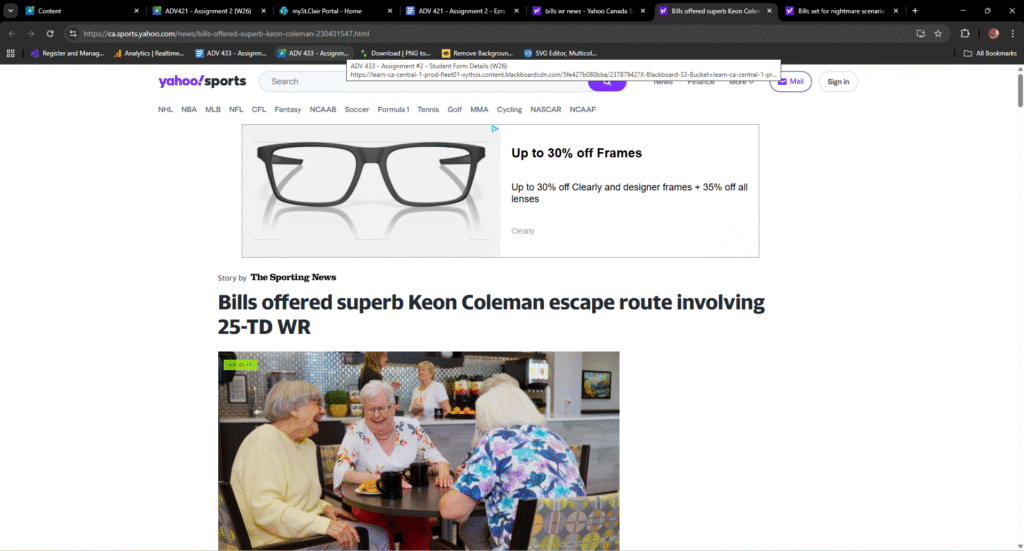
    Bills offered superb Keon Coleman escape route involving 25-TD WR

    b) Include the exact headline and a screenshot 

    Bills offered superb Keon Coleman escape route involving 25-TD WR

    c) Explain why you clicked it, not why you liked it 

    I clicked the headline because I saw the words “Bills, Keon Coleman, escape”. Simply put, I despise Keon Coleman; he’s a clown, and he won’t take his job seriously. My hatred of Keon Coleman, coupled with the hope that he would be released or traded, is why I clicked the link and read the article. 

    d) Tie your reasoning directly to course concepts 

    In class, we discussed a few things. The F pattern again comes to mind because of the way that it is laid out on Yahoo. The first words according to the F pattern that you read are as follows: Bills, Coleman, Escape. Based on the Target audience of this article (Bills Fans), most, if not all, are calling for Coleman to be let go. 

    The second thing that ties into the course concept is the use of an odd number, but this sort of combos with NFL knowledge because my first thought was “no wide receiver scored 25 touchdowns this season. Therefore, I was naturally curious, thinking “who is it?” Davante Adams was the touchdown leader in the regular season with 14, so this has to be false or misleading, which it was. The 25 touchdowns are over the course of Michael Pittman Jr.’s career. Sort of misleading, but still technically true. 

    Another thing we talked about in class was fear. For Buffalo Bills fans, they are afraid that we will not win a Super Bowl, even with the best quarterback in football, and the reason for that is that we do not have a good wide receiver. When we see this headline, the hope is that we don’t have to fear not having a good receiver for Josh Allen anymore, and we don’t have to fear another crushing playoff loss.

  • Part A question 2

    1. Accuracy & Representation (4 marks) Was the headline in Question #1 an accurate representation of the article content? 

    a) Explain your reasoning clearly 

    Yes, the article was an accurate representation of the headline. It contained the most notable performances and insights from the NFL combine, which includes good and bad performances. This article, based on my sights, is mainly for fantasy footballers. It did include what to know about the best and contrastingly worst performances at the combine. It did not, however, have full details on all 8 that they claimed they had. For each athlete, they had a detailed summary of this athletes performance at the combine. At the end, where I was expecting to see the 7th and 8th notable performances, they lumped two tight ends into the same section. This felt lazy and like they were embellishing the number in the headline. 

    b) Reference course discussion on misleading vs effective headlines
    I think that overall, this headline was effective, although the number 8 was a little sloppy in my opinion. In class, we discussed how you can’t mess with numbers (ie, lie), although it wasn’t technically a lie, you can write for a specific number or choose another way to phrase it. This headline was effective, though even with the sloppy number for a few reasons, the use of an odd number, the use of the F pattern, and captivating words within the headline, which we discussed a lot in class.